Worksheet
This page contains some exercises for computing some things using libsemigroups_pybind11.
-
Recall that the commuting graph of a semigroup \(S\) is the graph with nodes the elements of \(S\) and an edge \((x, y)\) if \(xy = yx\) holds. Let \(\mathcal{T}_n\) be the full transformation monoid on \(n \leq 5\) points. Show that the clique numbers of the commuting graph of \(\mathcal{T}_n\) are \(2 ^ {n - 1}\).
Hint
You can define \(\mathcal{T}_n\) as a finitely presented monoid in libsemigroups_pybind11 by doing:
You can also define the generating set and the corresponding monoid with:
Hint
You might want to use a python package for graphs to compute the clique numbers; see for example igraph.
-
Let \(S\) be the semigroup defined by the presentation $$ \langle a, b, c, d, e, f, g \mid abcd = a^3ea^2, ef= dg\rangle. $$
-
Show that \(S\) is infinite.
-
Partition the first \(1000\) elements of the free semigroup \(\{a, b, c, d, e, f, g\}^+\) so that words belong to the same part if and only if they represent the same element of \(S\).
Hint
See StringRange and congruence.partition
-
-
Is the monoid defined by the presentation $$ \langle x_2, \ldots, x_n\mid x_i^2 = (x_ix_j) ^3 = (x_ix_jx_k)^4 = 1\quad i, j, k \text{ distinct}\rangle $$ the symmetric group for \(n\geq 2\)?
Hint
-
Determine which of the relations in the presentation are redundant and which are not: $$ \langle a, b \mid a^4=1, b^2= b, ba^3ba= a^2(ab)^2, (ba^2)^2= (a^2b)^2 , (ba)^2a^2= aba^3b, a(ab)^4= (ab)^4 \rangle. $$ What is the minimal set of the relations in this presentation that define the same monoid?
-
Let \(S\) be the Catalan monoid of degree \(3\).
- Draw the left and right Cayley graphs of \(S\).
- Show that \(S\) has two non-trivial non-universal non-Rees congruences.
- Show that the lattice of left and right congruences of \(S\) are isomorphic.
-
Let \(J_n\) denote the Jones monoid of degree \(n\), and
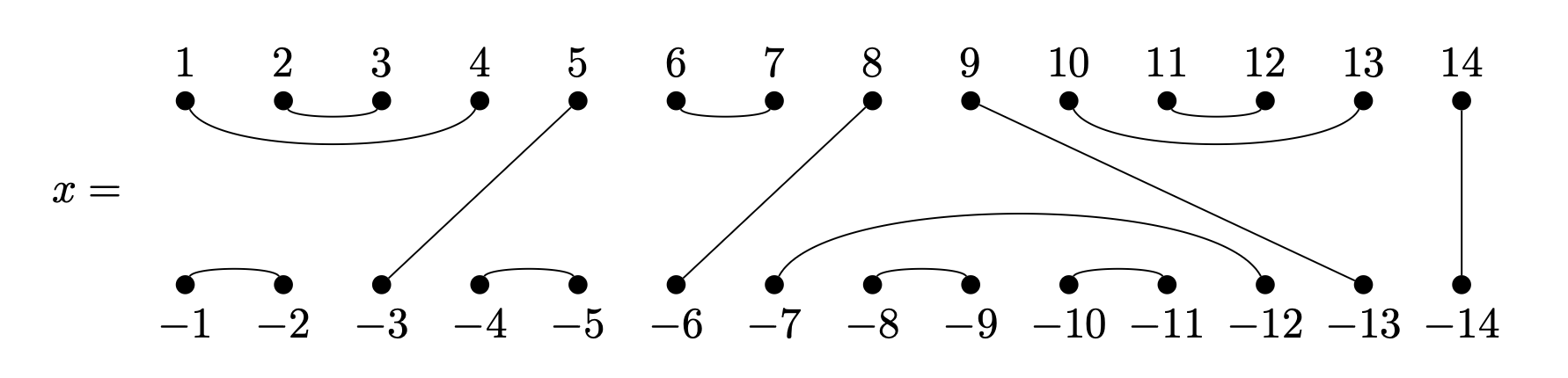
be a bipartition of degree 14.
- How many elements does \(J_{14}\) contain?
- How many idempotent elements does \(J_{14}\) contain?
- How many idempotent elements does the Green's \(\mathscr{D}\)-class of \(x\) in \(J_{14}\) contain?
- How many idempotent elements \(e\) such that \(7\) is in the same part as a negative integer does the Green's \(\mathscr{D}\)-class of \(x\) in \(J_{14}\) contain?
Hint
You can define \(J_{14}\) as a finitely presented monoid in libsemigroups_pybind11 by doing:
You could answer parts (a), and (b) using this presentation.
You can also define the generating set and the corresponding monoid with:
from libsemigroups_pybind11 import Bipartition, FroidurePin


def jones_identity(n):
    if n < 0:
        raise ValueError("the argument (an int) is not >= 0")

    return Bipartition([[i, -i] for i in range(1, n + 1)])


def jones_generators(n):
    if n < 0:
        raise ValueError("the argument (an int) is not >= 0")

    gens = []
    for i in range(1, n):
        part = [[i, i + 1], [-i, -i - 1]]
        part.extend([j, -j] for j in range(1, i))
        part.extend([j, -j] for j in range(i + 2, n + 1))
        gens.append(Bipartition(part))
    return gens


def jones_monoid(n):
    return FroidurePin([jones_identity(n)] + jones_generators(n))